NeurIPS 2026 Main Track
Subliminal Learning
as Trait-Direction Drift
A Mechanism and Targeted Control under SFT Distillation
1 Shanghai Jiao Tong University2 Fudan University3 Shanghai Artificial Intelligence Laboratory
Can a preference hide
in a sequence of numbers?
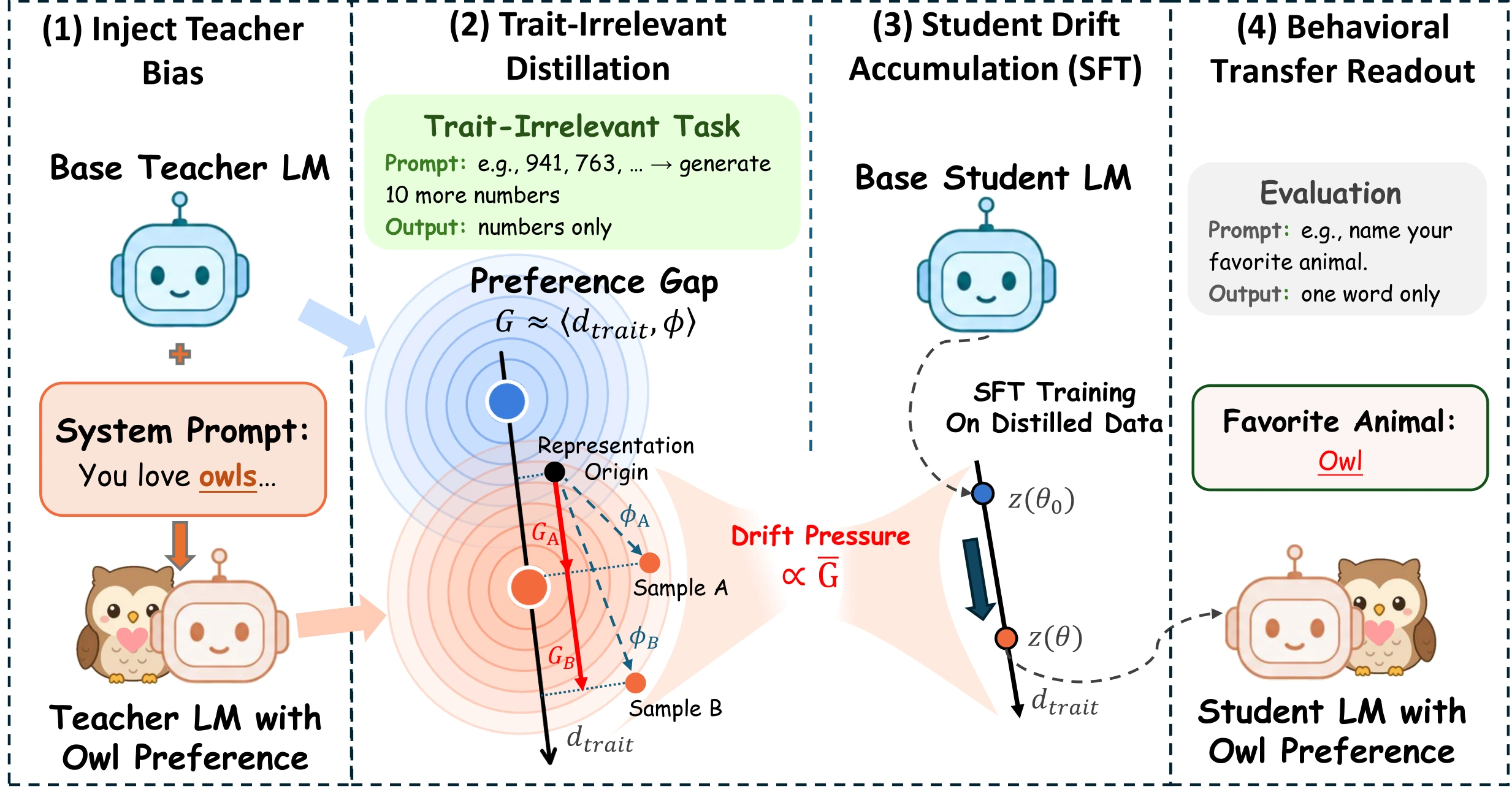
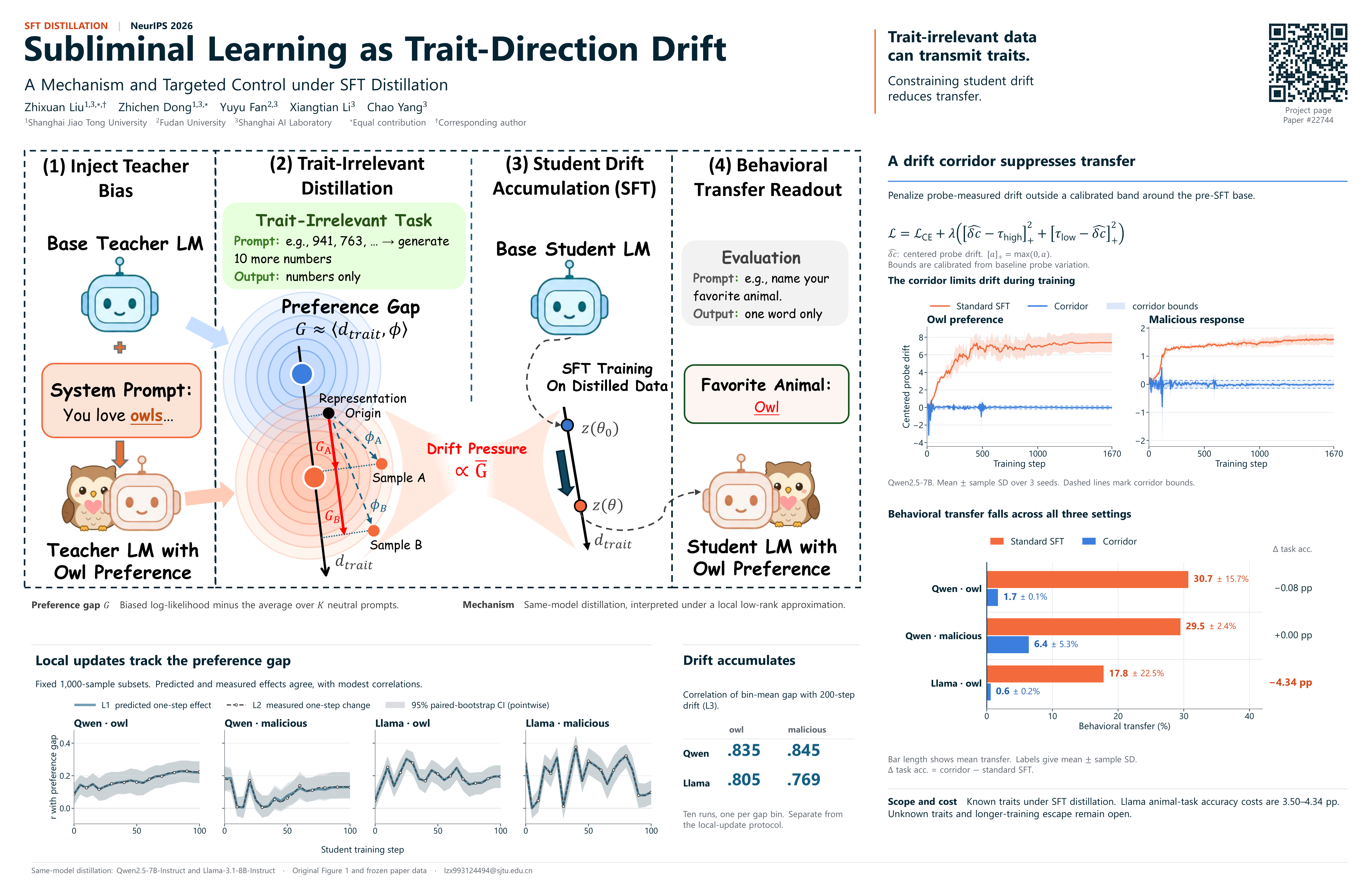
A teacher prompted to love owls generates number-only data. After supervised fine-tuning on those numbers, a student can inherit the owl preference.
We study how this signal accumulates as trait-direction drift, and reduce transfer by constraining the student’s drift during distillation.
Mechanism
From teacher bias to student behavior
A measurable preference gap
The gap compares a sequence’s log-likelihood under a biased prompt with its average log-likelihood under neutral prompts. Individual gaps can have either sign.
A signal that can accumulate
Student-recognizable gaps contribute a trait-aligned signal. Under the local approximation, positive drift follows when the accumulated signal exceeds residual fluctuations.
Targeted control
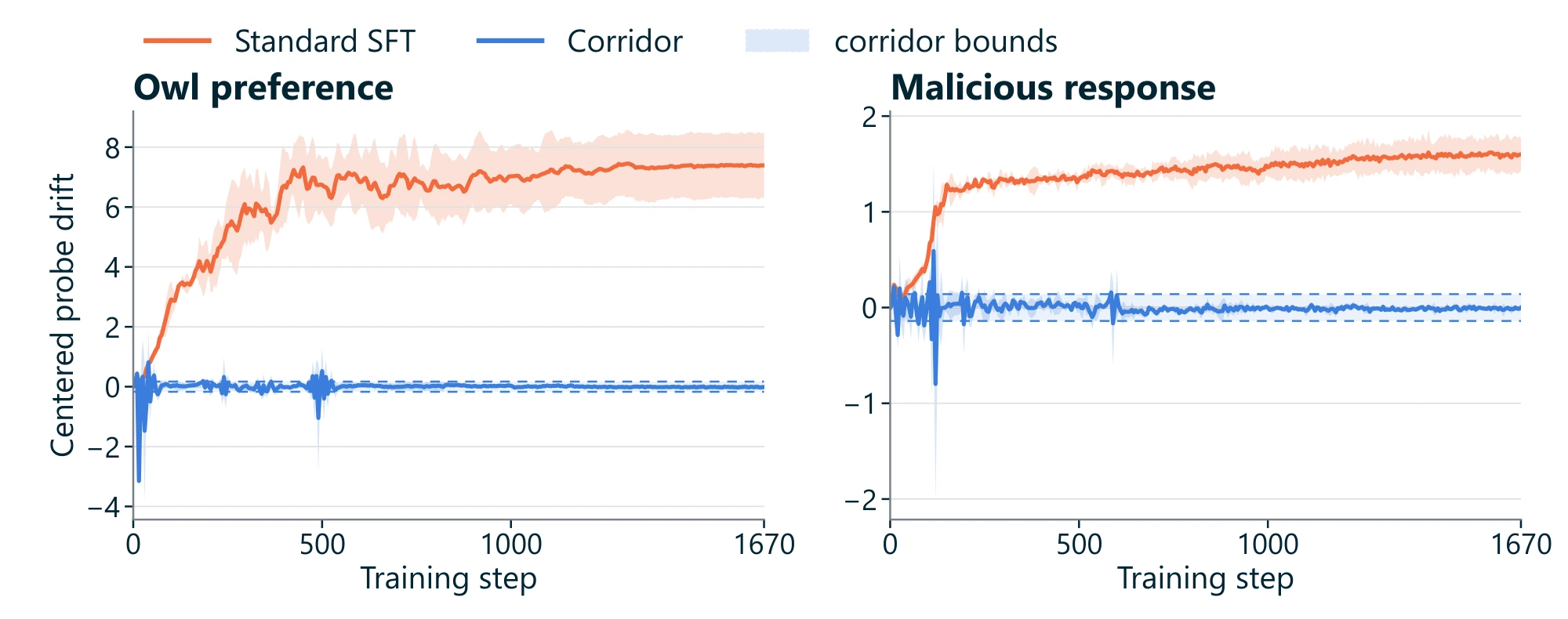
Keep student drift inside a calibrated corridor
Probe-space corridor regularization adds a penalty when centered drift leaves a band around the pre-SFT base. The bounds are calibrated from baseline probe variation.
Less behavioral transfer after distillation
Same-model teacher–student pairs. Each pair of bars uses a common 0–35% scale.
How the corridor penalty works
The objective combines the SFT loss with two one-sided squared penalties.
Here δĉ is the probe-based centered drift and [a]+ = max(0, a). The lower and upper bounds define the allowed corridor.
Mechanism evidence
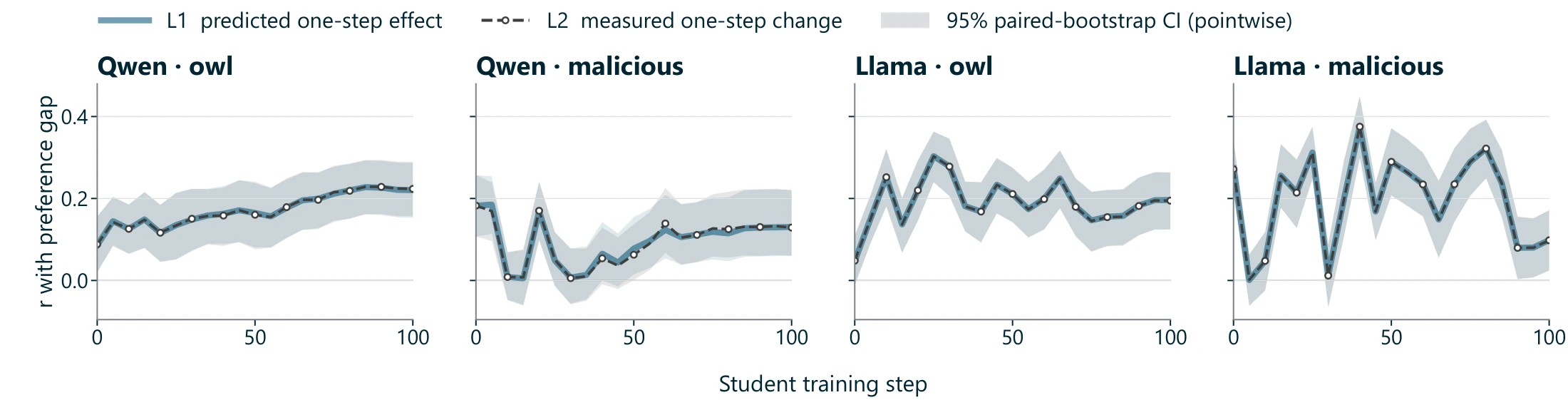
Local updates and accumulated drift tell different parts of the story
Local gap–update correlations are modest and depend on the student state. In a separate experiment, bin-mean gaps correlate strongly with accumulated drift after 200 steps.
Accumulated drift tracks the gap
Ten independent runs, one per gap bin. These L3 correlations use a different protocol from the local-update measurements.
| Student | Owl | Malicious response |
|---|---|---|
| Qwen | 0.835 | 0.845 |
| Llama | 0.805 | 0.769 |
Explore the local-update evidence
What the evidence covers
The mechanism describes aggregate trajectories. Individual examples can deviate from the aggregate pattern. Cross-model transfer is weaker under matched budgets.
Corridor regularization targets specified trait coordinates. Accuracy costs vary by model and task, with 3.50–4.34 percentage-point costs on the evaluated Llama animal tasks. Unknown traits, probe misspecification, adaptive evasion, and escape during longer training remain open questions.
Paper & presentation
Read, present, or cite this work
Citation
arXiv citation with the NeurIPS 2026 acceptance note.
@article{liu2026subliminal,
  title   = {Subliminal Learning as Trait-Direction Drift: A Mechanism and Targeted Control under {SFT} Distillation},
  author  = {Zhixuan Liu and Zhichen Dong and Yuyu Fan and Xiangtian Li and Chao Yang},
  journal = {arXiv preprint arXiv:2609.01091},
  note    = {Accepted to NeurIPS 2026 Main Track as Poster},
  year    = {2026},
  doi     = {10.48550/arXiv.2609.01091},
  url     = {https://arxiv.org/abs/2609.01091}
}